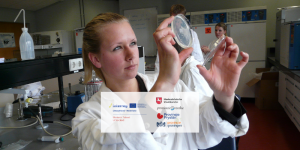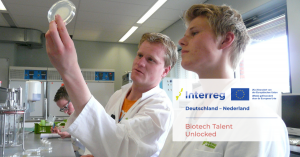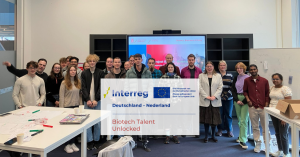
The first edition of the joint course “Anaerobic Digestion and Bioenergy Systems: Technological, societal & business aspects for the cross-border region Germany – North Netherlands” has been successfully completed. This unique interdisciplinary course was developed within the Biotech Talent Unlocked project by the partners Hanze University, NHL Stenden Leeuwarden, University of Groningen, and Hochschule Emden-Leer, and supported by Interreg EDR (Ems Dollart Region).
Dr. rer. nat. Bernd Schmietenknop, Hochschule Emden-Leer, said: “Based on the positive experiences, we have decided with our project partners to offer the joint course again this year within Biotech Talent Unlocked. We want to continue this successful interregional teaching module.”
Inspiring students for biotechnology
The joint course aims to motivate students for careers in biotechnology in the EDR region, with a particular focus on biogas and bioenergy. At the same time, students learn to work in international and intercultural teams, gaining exposure to different academic and professional cultures in the Netherlands and Germany. The course also enables knowledge exchange among experts from different universities and research institutions, giving students access to a broad network of expertise and practical experience.
The course ran from 11 November to 17 December 2025, carrying 3 ECTS credits. It was open to students who had completed a propadeutic year and was fully taught in English. Over six intensive weeks, students worked in international tutor groups on case studies from Bioclear Earth, a Dutch company specializing in environmental biotechnology.
Students deepened their understanding of anaerobic digestion technology, explored business opportunities such as biogas, biofertilizer, and carbon credits, and discussed the societal and regulatory frameworks for bioenergy. The course emphasized a combination of technology, business, environmental and societal aspects, intercultural collaboration, and project management. All findings were compiled into a structured advisory report and presented in a 15–20 minute presentation to a panel of experts and representatives from Bioclear.
Student highlights
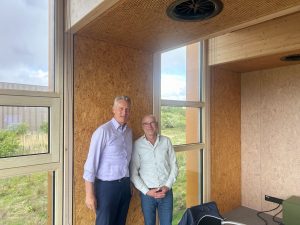
Students particularly valued the kick-off and final presentation day. Working in physical groups, visiting biogas facilities, and participating in workshops on project management and teamwork created a direct connection between theory and practice.
International collaboration was a key component, giving students the opportunity to work in interregional and intercultural teams. “It was fantastic to work together with students from Germany and the Netherlands on a real project and to test our ideas directly with experts,” said one participant. Tutors and mentors were praised for their guidance and feedback, which helped make the projects concrete and actionable.
Improvements and plans for 2026
Evaluations showed that the first days sometimes provided too much information at once. For 2026, more time will be allocated to team building, task allocation, and setting expectations and work styles. Project work will start earlier, with a clear schedule of in-person and online sessions, so students can achieve tangible results sooner. Tutors will receive additional preparation and guidelines to better support international groups.
Motivation and incentives are also being addressed. Differences in credit allocation between Dutch and German students can affect engagement. Options such as voluntary participation with ECTS credits are being explored to encourage active involvement.
The content remains challenging and multidisciplinary: students link technology to business opportunities and societal impact, develop their project management and communication skills, and work effectively in international teams. Projects continue to be practice-oriented, with real case studies and direct feedback from field experts.
Next steps
All partners have confirmed that the joint course will continue next year, even without Interreg funding. Based on the experiences and student evaluations from 2025, the course will be further refined and enhanced. Possibilities such as an additional day at a partner location for knowledge transfer and workshops are being considered.
The first edition demonstrates that the joint course provides a valuable and enriching experience for both students and instructors. Students gained insight into the biotechnology field in the EDR region, collaborated in international teams, and received direct feedback from experts across institutions. With the planned improvements for 2026, the second edition promises to be even richer, more dynamic, and more impactful.
About BTU
The Biotech Talent Unlocked project supports talent retention in Northern Netherlands and Northwest Germany and promotes the development of biobased companies and the green economy. The project is made possible by Interreg Deutschland-Nederland VI A and is supported by a broad consortium of partners: BIO Cooperative, Hanze: Life Science & Technology, University of Groningen, NHL Stenden University of Applied Sciences, BBENG, Hochschule Emden/Leer, and 3N Kompetenzzentrum e.V.