For many years, the Dutch-German border was not only a geographical divide but also a mental barrier for students, lecturers and companies. While the challenges on both sides are largely the same, from the need for well-trained biotech professionals to the transition towards a sustainable bioeconomy, cross-border collaboration was far from self-evident. With Biotech Talent Unlocked (BTU), a cross-border project supported by Interreg Germany–Netherlands, educational institutions, companies and knowledge partners from the Northern Netherlands and Northwest Germany set out to change that.
Through joint courses, company visits, student exchanges and encounters between companies and students, a cross-border network has emerged that will continue to exist beyond the lifetime of the project. “The greatest gain is that we now know each other and know how to reach one another,” says Mark Rüsch gen. Klaas, Professor of Chemistry of Renewable Resources and Polymer Chemistry at Hochschule Emden/Leer. “Those personal connections are now in place.”
A Shared Challenge
The reason for launching BTU was clear: both the Northern Netherlands and Northwest Germany face shortages of technical and biotechnological talent. At the same time, many young people leave the region to study or work elsewhere.
“In our region, we see knowledge and talent moving to other parts of the country,” says Dick Bonarius, Lecturer in Biotechnology & Immunology at NHL Stenden University of Applied Sciences in Leeuwarden. “That is exactly why it is important to break down barriers and make the region more attractive for knowledge workers and skilled professionals.”
According to Frank Köster, Project Manager at the 3N Competence Centre in Werlte, the project was therefore not only aimed at education, but also at increasing awareness of career opportunities within the region. “Many students are simply unaware of the opportunities available just across the border.”
Students Crossing Borders – Literally and Figuratively
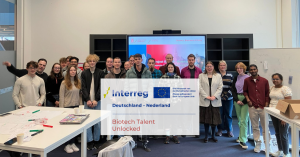
One of BTU’s most important achievements has been creating opportunities for people to meet. Students visited companies, took part in joint activities and got to know fellow students from across the border.
“For many Dutch students, Germany was hardly on their radar,” says Janneke Krooneman, Professor of Bioconversion and Fermentation Technology at Hanze University of Applied Sciences Groningen. “Through excursions, workshops and exchanges, they discover that their world is larger than their immediate surroundings.”
Bernd Schmietenknop, lecturer at the Faculty of Engineering at Hochschule Emden/Leer, observes the same on the German side. “For our students, Groningen is only an hour away, but before the project there was hardly any exchange. We managed to break down that wall a little.”
For German students, this has also opened up new opportunities for internships, graduation projects and employment, as the biotech sector around Groningen is considerably larger than in the immediate Emden-Leer area.
Companies Benefit Too
Through meet-and-greet events, company visits and joint activities, companies were able to connect directly with potential interns, graduate students and future employees. According to Frank Köster, this is much needed. “Many companies in Germany simply do not know what opportunities are available just across the border, even though Groningen offers excellent facilities and is home to more than 30,000 students.”
And this lack of awareness exists on both sides of the border. The project partners see these accessible networking activities as particularly promising for the future. “For companies, it is a great opportunity to showcase themselves and meet new talent,” says Janneke Krooneman.
This experience is shared by Bioclear earth B.V.. Jeroen Tideman, Senior Advisor Bioenergy, sees the greatest value in the direct interaction with students and educational institutions. “Through the training activities, we had the opportunity to present our company. This increases our visibility among students and may spark their interest in internships. In addition, we received valuable input from students on the practical case studies we presented, while further strengthening our network with the universities of applied sciences.”
Looking ahead, Bioclear earth also sees considerable opportunities in cross-border collaboration. Tideman explains: “By investing together in talent development, we can help maintain a strong knowledge economy in the Dutch-German border region. We see particular opportunities in the fields of the energy transition, the agricultural transition and the biobased economy.”
Collaboration Turned Out to Be Easier – and Harder – Than Expected
Interestingly, the biggest challenges were not related to content. “We never really had discussions about what we wanted to teach,” says Mark Rüsch gen. Klaas. “When it came to content, we were always quickly on the same page.”
The real challenges proved to be organisational. Educational systems, curricula, schedules and decision-making processes differ significantly between the Netherlands and Germany. “Perhaps we underestimated at the beginning just how differently universities of applied sciences are organised,” says Krooneman. “You first need to understand how the other organisation works before you can develop something together.”
At the same time, the partners discovered that the substantive challenges were surprisingly limited. The topics students and companies deal with, such as sustainability, biobased applications and the energy transition, are largely the same on both sides of the border.
From a Joint Course to Lasting Collaboration
One of the achievements the partners are particularly proud of is the development of joint educational activities. For Bonarius, the joint biogas course stands out in particular. “The fact that two universities of applied sciences and a university managed to provide education together across the border and align this with existing credit structures was far from self-evident. I am proud that we succeeded.”
Another educational achievement was the successful pilot of a business challenge in which students from a research university and a university of applied sciences worked together on a challenge provided by a biotech start-up. “You could see how the complementary the skill sets of the students helped to formulate an advice that was both strategic and technically feasible,” observed Marion van Rijssel, Lecturer at the University of Groningen.
According to the partners, it was not only the educational activities themselves that mattered, but also the relationships that emerged from them. Students now find it easier to access internships and graduation projects across the border, while lecturers continue to collaborate on new initiatives beyond BTU.
A Project Ends, the Network Remains
Although BTU will officially come to an end in December 2026, the partners expect several activities to continue. Student exchanges, internships, joint courses, excursions and meetings with companies are among the initiatives most likely to endure.
“The contacts have been established and the lines of communication are short,” says Krooneman. “We now know what we can offer one another and where the opportunities lie.” Mark Rüsch gen. Klaas is equally optimistic. “Student exchanges and joint research projects will continue. They no longer depend on the project itself, but on the relationships that have been built.”
Perhaps that is the most important outcome of Biotech Talent Unlocked: not a single course, company visit or event, but a network of people who know how to find each other. A network that has made the border between the Netherlands and Germany a little smaller for students, lecturers and companies – and one that will continue to exist long after the project itself has ended.
About BTU
The Biotech Talent Unlocked project supports talent retention in the Northern Netherlands and Northwest Germany and promotes the development of biobased companies and the green economy. The project is made possible by Interreg Deutschland-Nederland VI A and is supported by a broad consortium of partners: BIO Cooperative, Hanze University of Applied Sciences – Life Science & Technology, University of Groningen, NHL Stenden University of Applied Sciences, BBENG, Hochschule Emden/Leer and 3N Kompetenzzentrum e.V.